Tuesday, February 1, 2011

A Book Read - Bonhoeffer - Eric Metaxas


If ever there was a perfect storm for evil - surely 1930's Germany was it? How did a country with such a proud intellectual and cultural history descend into such a base level in-humane path? And how could the whole nation be swept up in it?

Well as this book points out, not everyone was swept up in it, in fact a number of people at great risk to themselves actively opposed this great wrong. This story is worth every minute of reading, what a fascinating man, in a fascinating time, involved in some extraordinary actions against an extraordinary evil - in the name of his crucified Lord...

I loved this book 9/10.

A Book Read - Church Planting is for wimps


I'm not sure why it has taken me so long to post again about books - because there has definitely been some read since Feb last year!!!

Anyway - this one by Mike McKinley is a good read, a sensible call to move beyond 'celebrity church planting' that seems to be an increasing influence in evangelical circles, and coming from a young guy - who should by current form be more up for the celebrity way of doing things.

All in all a lot of commonsense about the task at hand in being involved in a small church trying to get it together. I liked what he had to say, much of which I had come to the conclusion of previously, such as not really needing a mission statement:

"Look, if you don't know what you're supposed to be doing as a church planter, if you need to write out a statement in order to remember that your church is supposed to evangelize the lost and help Christians grow in Christ, friend, your shouldn't be a church planter. How about casting the vision the way Protestants have cast vision for the past 500 years! teach God's word! Explain it to God's people, and tell them God's Mission and vision and values and strategy for their life. Don't refer them back to some mantra that you make sure everyone in the congregation has memorized. Teach them what the Bible says about what it means to be a faithful Christian and a faithful Church." p62.

Definitely worth the couple of hours it took to wander through it - I'd say a solid 7.5/10!

Sunday, February 14, 2010

A Read Book - Introverts in the Church - Adam McHugh


I wanted to read this book - I thought it would be a nice change from the usual chest-beating stuff on church leadership in particular that usually winds up making you think their basic premise is to be a better leader you need to be more me, and less you!!

In the end it probably has the same sought of vibe, just zigging while everyone else is zagging - so it is going to have some good insights.

I found the book to have some good insights into the world of the introvert, and in particular what it would mean for an introvert in ministry, in getting things done, but also in terms of the relationships aspects that is quite at the forefront of this kind of vocation.

It helped me to clarify that I have a tendency towards deeper relationships with a few people, than surface relationships with a lot of people (which is handy because I can't help think the two other people in my family will help to balance that out!).

So some unusual observations for some self evaluation and indeed future planning and action.

BUT - and it is a BIG BUT (if you'll pardon the expression), the book analyzes everything so much through the grid of an introvert it felt rather self indulged and self obsessed at points - some times I wanted to say 'get over it, we can't always have things on our terms'.

And this is nothing compared to what I was saying when he was outlining some of his introverted meditation ideas - it pained me beyond belief to see that IVP would publish a book that was essentially recommending medieval Roman Catholic approach to how we know God..... (see the cloud of unknowing if you are not sure what I mean).....

I really disliked that this book was far from Evangelical in it's theology of Revelation......

If it had of just been a practical observation book, I probably would have lent it to people, but with theology as poor as that - I really wouldn't want to lend it to anyone!!

A Read Book - A couple of Bill Bryson


There is something about being in a airport (recent trip to NZ) that makes me want to read Bryson - it is a close as I ever get to reading a novel.

I know I will laugh audibly at least every couple of pages - is there anything better to do when you are sitting in a confined space with complete strangers......

No wonder they won't give me real cutlery!!

A Read Book - Why we love the Church - Kevin De Young


I was really looking forward to reading this book, but in the end didn't really feel like it hit the mark. Not because of the book itself so much, just that it is clearly written into a Nth American Christian context that is just very different to the context I find myself in.... maybe it's just because we are a bunch of socialists ;) (let the reader understand!)

An ok book - I guess I was just hoping for a little more cash value out of it for the life of our church.

I still like this guys writing and theology and will try the next one he puts out.

I'd give this a 5/10 (unless you live in the same context as the writer aimed at and I'm sure it would have been really helpful)

A Read Book - Guide Us, Guard Us - J.I. Packer


Read this one just after PDJ (see below), again a worth while read particularly in conjunction with that book. It is always good to cross pollinate your ideas with another sound Christian mind who resides in a slightly different gene pool.

In a different style and way had a lot to contribute to thinking about the Christian life, and the thinking about what does it mean to call God our shepherd is a really rewarding exercise (I remember Paul Barnett doing a similar thing at college and it was excellent).

The one area I am not certain about is Packer's view on what it will mean for us in our life's situation to 'have the peace of God which surpasses all understanding, guarding your hearts and minds in Christ Jesus'. He took that to mean it would be a concrete reality in each instance. I kind of think it is more likely to mean in a general sense we have a confidence because 'we now have a peace with God', that enables us to face each instance in a new way.

Maybe I misunderstood his point - because it seemed like a slightly 'emotional response' from a stalwart of Evangelical Christianity. Anyway that would put my thinking on this issue at the moment somewhere between packer and PD Jensen - which to be honest is a comforting thought.

I'd give this one a 6/10

More Thoughts on Preaching


This is an outline of what I think about when I am trying to make a point (not three - never three!) in preaching!!!

A Read Book - Guidance and the Voice of God - Phillip Jensen


This book is classic Philip (the mostly good, the slightly frustrating, and the always parochial!).

It started life as a sermon series for uni students and shows it's heritage in that it was always going to be finite in scope. There is much taught clearly in the book - as you would expect - but being a sermon series not always at the depth that some would hope for.

I think the image of the God given compass in life is an excellent way of starting to address the challenges of decision making in life.

But I still have a nagging suspicion that in the attempt to stand against a 'charismatic' approach of decision making - that can best be described as emotionalism - this book's approach falls more into the category of 'Evangelical Rationalism'.

I find Graham Cole's approach in 'he who gives life' a more convincing and more mainstream position to the role of the Spirit in the life of the Christian today.....

A worth while read and an important corrective to a lot of rubbish out there on the issue of guidance.

I'd give it about a 7/10

A Read Book - You Can Change


Biblical, Theological and Practical - A seriously useful book that I have suggested lot's of people read on the issues of sanctification and how can we live as Christians in a way that is more like Christ - and the answer isn't - try harder!!!

I'd give it a 9/10

Tuesday, October 20, 2009

Tuesday, September 15, 2009

Nice!!

Mark Thompson Moore Lecturer writing here:

'I'm also rather tired of evangelicals attacking the doctrine of biblical inerrancy. Like most who have thought about these things, I certainly recognise the difficulties with the term 'inerrancy'. I also understand and deplore the abuse of it in certain circles, particularly in the service of ecclesiastical politics. I'm prepared to admit that I am less than satisfied with some of the standard expositions of this concept and would like to see it presented with more rigour and careful nuance. But I remain committed to biblical inerrancy. The Bible is not only effective as an instrument in God's hand to accomplish his purposes, it speaks of things as they really are. For all the literary variety and the rich textures which stem from different authors in different situations and with different goals, it is still possible to speak of the Bible's own investment in the question of truth and truth understood in terms of a correspondence with reality. 'Utterly truthful' and 'absolutely reliable' might be better expressions because they are at least positive rather than negative and put the accent on biblical priorities. Yet the term 'inerrancy' is an ancient one, long predating the advent of modernism and even the Reformation. Too much is lost when it is denied or excluded.

It is been said that evangelical theology has always been under attack at two points above all others — the doctrine of Scripture and the doctrine of the atonement. This has proven to be the case throughout the twentieth century and continues to be so in the twenty-first. It is tragic that these attacks have increasingly been mounted from within the evangelical constituency.'

Sunday, September 13, 2009

Wednesday, September 9, 2009

Ain't that the truth

The Stench of Christianity

So the Jesus All about Life campaign is about to kick off and part of me wonders how ready really, Christians are for it?

I mean I think people are ready for people to come out of the woodwork to talk about Jesus and the meaning of Christianity, but are they really ready for the other response that is just as sure to come?

Paul said Christians offer the fragrance of life to those who are being saved, but the stench of death to those who are perishing.... And let's face it, people respond strongly to bad smells!!!

SO today's paper we see it start,

What utter arrogance and discrimination. What gives these people the right to hoist their beliefs above everyone else's by making absolute statements about how the universe is constructed. Ignoring the fact they have no evidence whatsoever for their fairy tale beliefs, they are by default saying that everyone else's are wrong.
I have no objection to them holding these beliefs, but they should keep them to themselves and away from impressionable youth and the emtionally and mentally vulnerable.
Oh wait, that's exactly who they want to target.
ozathiest | Sydney - September 10, 2009, 8:20AM


That's a cheery conversation starter, oui???

Either way I think we will see some positive responses, some strong negative responses, and more than likely the majority will be apathetic responses from a people who are more concerned with function of the day to day, rather than its meaning or purpose!!

Blind Faith or Numbers???

Yesterday there was an article in the paper, on how in essence, we as a society are "free" from the shackles of old fashioned conformism to make choices about our life and relationships.

"If you had said years ago that we would see many more people living together before marriage and double the number of kids being born out of wedlock, moralists would have seen it as proof of the decline of civilisation and the collapse of our moral fibre. But the reality is that the taboos we once thought immovable are completely flexible."

Salt believes such shifts show our maturity. "People are less preoccupied with sexuality and more concerned about discrimination, with sexism and racism and even with sustainability. Who cares if you're gay? Who cares if you live together without getting married?"

Likewise, the significance of marriage has diminished.

"People care less about the actual marriage, so they don't mind having kids outside of it."


I was thinking - it's a little bit of a simplistic presentation - all choices have consequences, where is the truth about those? Choices about sexual lifestyle affects your health - the numbers bear that out. Broken marriages affect people, especially children. But where is the acknowledgement of that???

It is really undergirded by a secular utopian blind faith, that is out of touch with our reality....

And that is what another article today points towards..... We make choices - good and bad and they have consequences.... but then the Bible has been saying the same thing for years - and now the stats show it might have actually known what it was talking about!!!

The three annual surveillance reports, to be presented at the Australasian HIV/AIDS Conference in Brisbane today, show that indigenous people, intravenous drug users and men who have sex with men are increasingly affected by HIV/AIDS, infectious syphilis and viral hepatitis.


Unprotected sex is also linked to an increased risk of cervical, oral and anal cancer and the risk rises with increasing numbers of sexual partners.

A 2007 study published in the New England Journal of Medicine found that people who have had more than five oral-sex partners in their lifetime are 250 per cent more likely to have throat cancer than those who do not have oral sex.


It is a challenging area no doubt, especially for certain groups within our society, but unless we are willing to genuinely engage with reality, the stats of lifestyle choices and not a relativists "all choices are good" - how do we expect the situation to improve??

The ready availability of pornography and representations of teen and adult sexuality in advertising and popular culture could negatively influence the way children and teenagers view sex, she said.

''Young people who are not informed or ready for sex education are being inundated with messages encouraging sexual behaviour that they are not ready to process and do not understand the consequences of.''

Saturday, August 29, 2009

Some thoughts on books I read in 08

'The God who is there' - Francis Schaeffer.. I really enjoyed this book. It challenged me a lot about the importance of understanding the claims of the Christian faith about the historical Jesus - which was a little suprising from a philosopher. A great help and encouragement to consider the validity and importance of an integrated Christian view of life. Although written prior to post-modernism it in real ways sees some of it's problem's before time. The 'cultural refernces' now seem quite quaint, the Christian view of life he commends is anything but quaint. It was my first read of any schaeffer, I will read more, in face at some point I will need to read this again!!


'Leadership on the Front Foot' - Zac Veron (no relation to juan sebastian veron as far as I know!) - A useful read for someone doing ministry, expecially within the Sydney context. To the point - well literally it is 23 points - of practical wisdom. At times it feels a little gung ho about it all, but speaks with a clarity that you like to hear when you are trying to untie the gordian knot that is parish ministry, especially in a multi parish setting. I liked it and it was easy to get the points in practical ways.

'Living with the Underworld' - Peter Bolt. [The blurb reads, 'In Living with the Underworld, Peter Bolt brings his quirky and humorous style to his topic, and makes his book hard to put down because it is so fascinating and engaging.' Well hate to disappoint them, but I found it easy to put down, and in fact gave up on finishing it. I found it a real dissapointment, it was supposed to be a homage to the Sopranos, it was a little more pulp theology. I needed some serious help, this book was not it!)

'Knowledge of God and Service of God' - Karl Barth. (Given as a set of lectures about natural theology (which is funny in itself!) it actually is a good book to get something of the essence of Barth, distilled down into a more manageble read. He is an enigma, so much genius, so many simple things confused!!)

'Suprised by hope' - Tom Wright (not a bad read, he has a good main point about the life after the life after death, but in typical style, his style is more impressive than substantive, which means there are some odd moments of madness for mind!)

Sunday, August 23, 2009

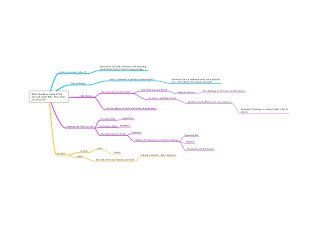
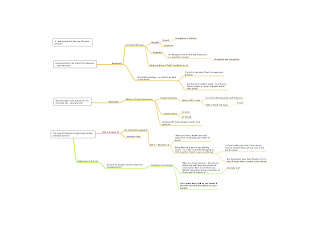
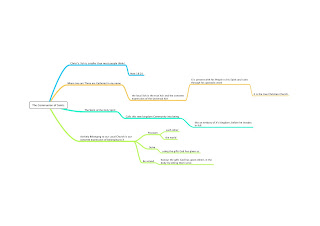
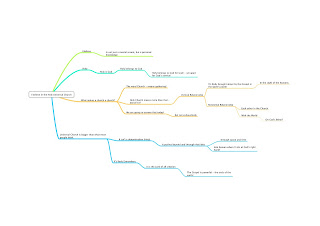
Mind Maps and Preaching


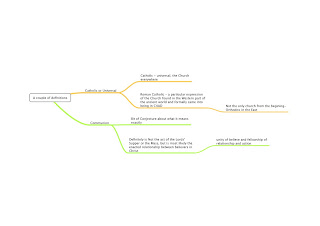
Recently I have changed over from a full script when preaching like this one for example , to using mind maps to preach from.

The main reason started when we were doing a series on the Apostle's Creed and I have always found Systematic Theology to be much more engaging and useful as teaching, when it was a conversation rather than a lecture (ie. PFJ 3rd year for those who know those sought of things!).

It turns out I am not alone in this, and a series on the Apostle's Creed which was questioned by people before hand as to why we would bother, turned out to be a series that really engaged people and in the end helped them to see its value and to grow together in our understanding.

We are in a context where the congregation size is usually closer to 50 than 150, and so a more conversational style of preaching is easy to use, and in a lot of ways I believe a more effective way of teaching and engaging with people around God's word.

Mind maps are a much quicker and more effective way (than a full text) of ensuring you cover the essential points in a conversation, without the danger of repeating yourself. It helps you to pick a path for the conversation before hand (ie. is this a good point or an unhelpful sidetrack to be cut off at the pass!), while making it easy to cut/change/modify on the run as you need. It really acts as a safety net so you don't miss talking about the gems you have found during your study.

Dialogue is all very trendy and post-modern, but the reality is within certain size limitations it is a much more effective means of God's people meeting. Not a vacuous wander through the garden dialogue, but a well prepared trip through a topic (like a good tour guide maybe), that helps a teacher/preacher engage with the REAL questions of the congregation.

Anyway I have posted some of the Mind Maps I used for the topic of the Catholic Church below - I use a program called Mindnode pro (Mac), and the outline I gave to the congregations.

Since we have gone back to an expository series I have modified my style of preaching. I have kept the mind maps and made sure the preaching/Teaching consciously uses interactive/conversational elements within it - you can here some attempts at it here.

Anyway that is where I am up to at the moment!!!

Thursday, August 13, 2009

Busy?

9 times out of 10 when I ask anyone how they have been, they say, 'busy'. Like somehow not being busy is the cardinal sin today. CJ Mahaney offers the opposite that maybe being busy is the problem. The solution isn't so much doing less - but in being more discerning in what it is we do (that is very funny to write on a blog - the height of futility!!).

I like things that help me to work smarter and not just harder, and even better when they are written from a solid Christian perspective, picking up on the foundational nature of the Christian life, and building out from that, in seeing that life is about relationships and not just tasks.

Biblical and practical without being simplistic - so obviously it appeals to me. Download it here for free and have a read, then have a go!!!

Monday, August 10, 2009

Good Questions when reading theology!

Total Church Questions:

1. In your own words how would you briefly summarize the main point of this chapter? (ie. in one line what are they on about?)

2. Was this a new idea in the book up to this point? (ie. How does this chapter relate to the rest of the book so far?)

3. Was this a new idea for your Christian thinking at this point in time?

4. How does the author back up their main point in this chapter? (ie. how do they develop their argument, what are the minor points they make to support their main point?)

5. What is the authority that their main point is based upon? (Is their main point supported directly from the Bible or is it inferred from the Bible, or is it based upon observations of life, culture, group dynamics, logic or philosophy etc?)

6. Has the author made some assumptions in their argument? And do you think they are good ones?

7. What did you like about what the author had to say? (and Why?)

8. What didn’t you like about what the author had to say? (and why?)

9. Are there things that you think are going well for you/us based on what the author is proposing?

10. Are there things you think you/we should change because of what the author is proposing?